AI Scribe
An agentic documentation partner that turns a therapy session into a note clinicians can review in minutes and trust.
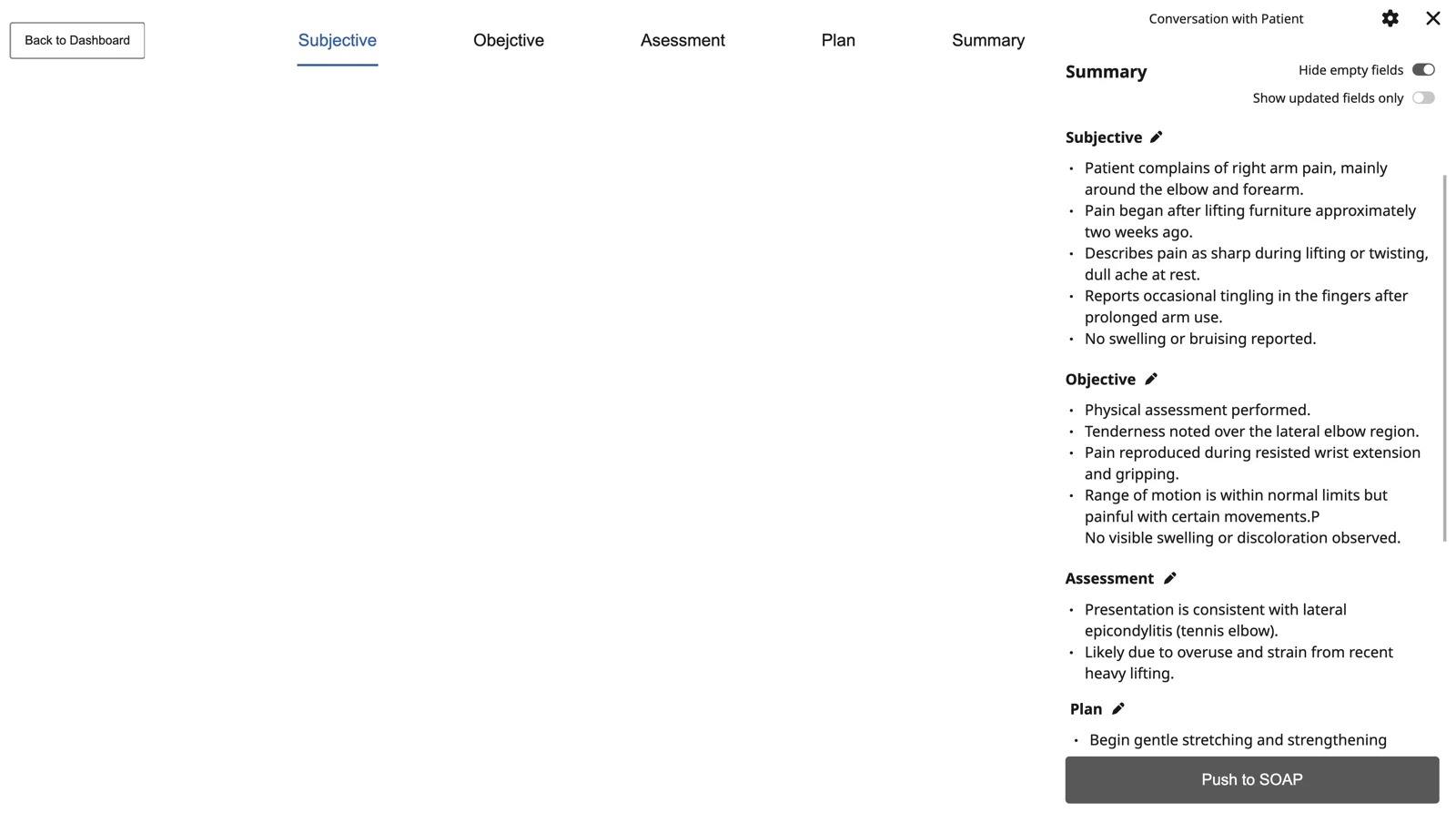
Screens from my design file. All patient data is synthetic.
AI was writing the note. Clinicians were rewriting it.
Physical therapists write a structured SOAP note for every visit, and much of that writing happens after hours. AI Scribe was meant to take that work away.
The first version listened to the session and wrote its summary straight into the note. There was no step to check it first. Therapists ended up rereading every field, moving details into the right section, and fixing data the AI had overwritten. Some notes were lost to endless loading.
For a clinic, an inaccurate note is more than rework. It is a Medicare compliance risk and a denied claim.
Corrections on top of documentation time, not instead of it.
Overwritten eval data, details in the wrong section, lost drafts.
Audit exposure and denied claims when notes fall short.
Therapists need a way to turn a session into an accurate SOAP note they can verify quickly, because unchecked AI output costs them time and puts their clinic's claims at risk.
make an AI-drafted note fast to review and safe to trust, without taking control away from the clinician?
How the work moved.
Four things we kept hearing.
From field feedback, clinician usability sessions and support threads. Each one became a design change.
17 issues, 5 themes.
Every complaint from the field went on the board. Filter by theme.
What other AI scribes do, and the gaps we owned.
| CAPABILITY | NABLA | FREED | HEIDI | OUR V1 | REDESIGN |
|---|---|---|---|---|---|
| Mic check before recording | ✓ | ✓ | ✓ | ||
| Clear failure states | ✓ | ✓ | ✓ | ||
| Edit the note by instruction | ✓ | ✓ | ✓ | ||
| Instructions by voice | ✓ | ✓ | |||
| Per-section style and detail | ✓ | ✓ | ✓ | ||
| Highlight what changed | ✓ | ✓ | |||
| Patient consent step | ✓ | ||||
| Compare with previous visit | ✓ | ||||
| Agent asks clarifying questions | ✓ |
From a hands-on teardown in early 2025. A dash means not observed.
From opening a note to completing it.
Every path a clinician can take, including consent and the Review Agent. Decisions are diamonds.
Redrawn from my working flow in FigJam.
What documenting with v1 felt like.
- “Typed corrections have been really good.”
- “The review window doesn't show if there is data already.”
- “He wants bullet form, org-wide.”
- Can I trust what it wrote?
- Will this note hold up in an audit?
- Is it faster to just type it myself?
- Rereads every field before signing
- Moves details into the right section
- Finishes notes after the last patient
- Wary when the AI fills in tests it didn't hear
- Relieved when the draft is close
- Frustrated when a note disappears
Who we designed for.
“I don't mind checking the note. I mind rewriting it.”
- Finish notes before leaving the clinic
- Notes that pass Medicare review
- Keep the clinic's note format
- Rewriting what the AI got wrong
- Eval data overwritten without warning
- Can't see the note while using Scribe
- Back-to-back visits, little time between
- Web EMR in clinic, phone on home visits
- Comfortable with tech, wary of AI guesses
A composite built from field feedback and usability sessions, not a single real clinician.
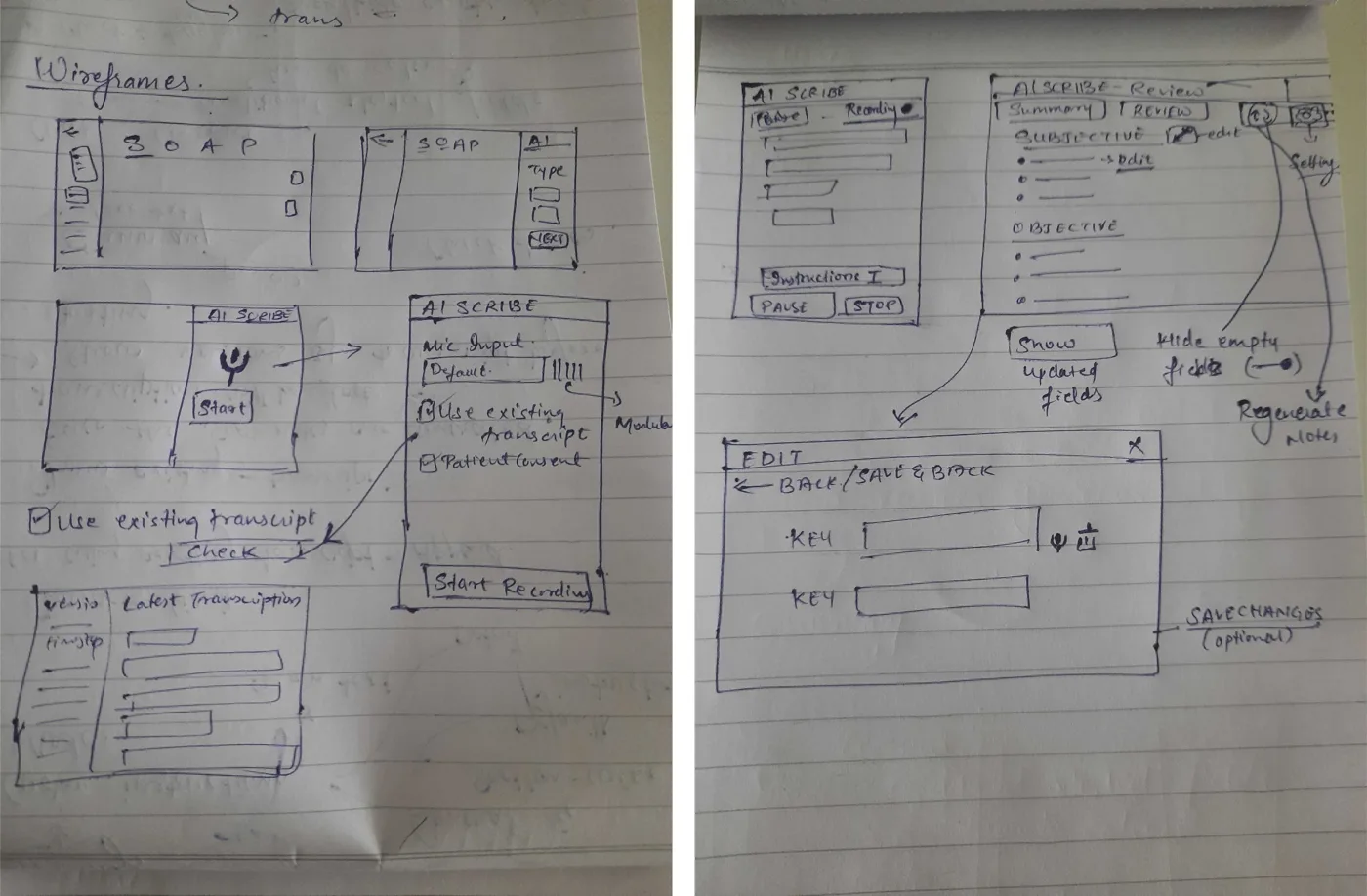
With the research in hand, I sketched on paper first.
The panel beside the note, the review list and the edit window, before any screen.
The Scribe panel, screen by screen.
It sits beside the SOAP note, so clinicians never lose sight of what they're signing. Pick a screen.
Review. Every extracted field has a checkbox, so clinicians choose what goes into the note. Toggles hide empty fields or show only updated ones.
Screens from my design file. All patient data is synthetic.
Three tiers, one clear winner.
Switch the tiers and watch the note change.
Tolerated session well. BP 128/82 → 134/86, HR 74 → 92.
They liked it. They just hadn't found it.
Accent bar, New badge, always-visible chips. Collapses once enabled.
Same review model, in a bottom sheet.
For home-health therapists documenting between visits.
Six calls that shaped it.
Show the steps
Trust came from seeing the process, not just the output.
Review before save
Nothing reaches the note until Push to SOAP.
Correct by instruction
Tell the agent what's wrong, by typing or voice.
Lock the toggle mid-session
Switching mid-recording created error states.
Previous visit, inline
Side by side doubled the reading; inline shows change at a glance.
Direct memory editing
People expected it to change the current note. It didn't.
1 in 12 notes → 1 in 4.
Production data, Jan–Sep 2026, rounded. A note counts once if any Scribe session ran on it.